
Last February, on a beach walk looking for shells and beach glass, I found something that was neither.
I was up on the dry sand, away from the water, when I spotted a little scatter of old paper. Torn edges, soft with age, the kind of find that makes my heart skip a beat because I already know what I'll do with it. Collage fodder, I thought, and started gathering it up.
Near the scraps was a folded square of paper that looked like trash at first. It wasn't. It was a letter, four pages, dated April 16th, 1972.
It was written entirely in Spanish, so I had no idea what it said. Standing there, I wondered if I'd found a message in a bottle. How else does a letter from 1972 turn up on a beach still mostly intact? I planned to get it translated, tucked it in with the rest of what I'd collected, and then life happened. I got home, got busy, and the letter sat forgotten for months.
I only came across it again recently. This time I sat down to find out what it said.
Querida Novia
The letter opens with those two words. Querida novia. Dear girlfriend, or maybe dear fiancée, the kind of address that tells you everything about the relationship before you've read another sentence.
It's written by a young man named Pablo, writing from aboard a ship. He mentions the boat again and again, restless, drinking too much coffee out of boredom, the strange rhythm of days with little to do but eat, sleep and wait. Somewhere out on the water, missing home, he sat down with a pencil and tried to close the distance the only way he could.
He tells her he's received her letters and is glad she's well. He asks after his mother. Then he gets to the part that touched me most, why he didn't come to the door to say goodbye.
"No fui a la puerta porque estaba seguro que no me iba a poder ir."
I wasn't going to be able to leave, he tells her, if he'd had to look at her one more time. A knot in his throat, an ache in his chest. He'd rather she think him distant for a moment than watch him fall apart in front of her.
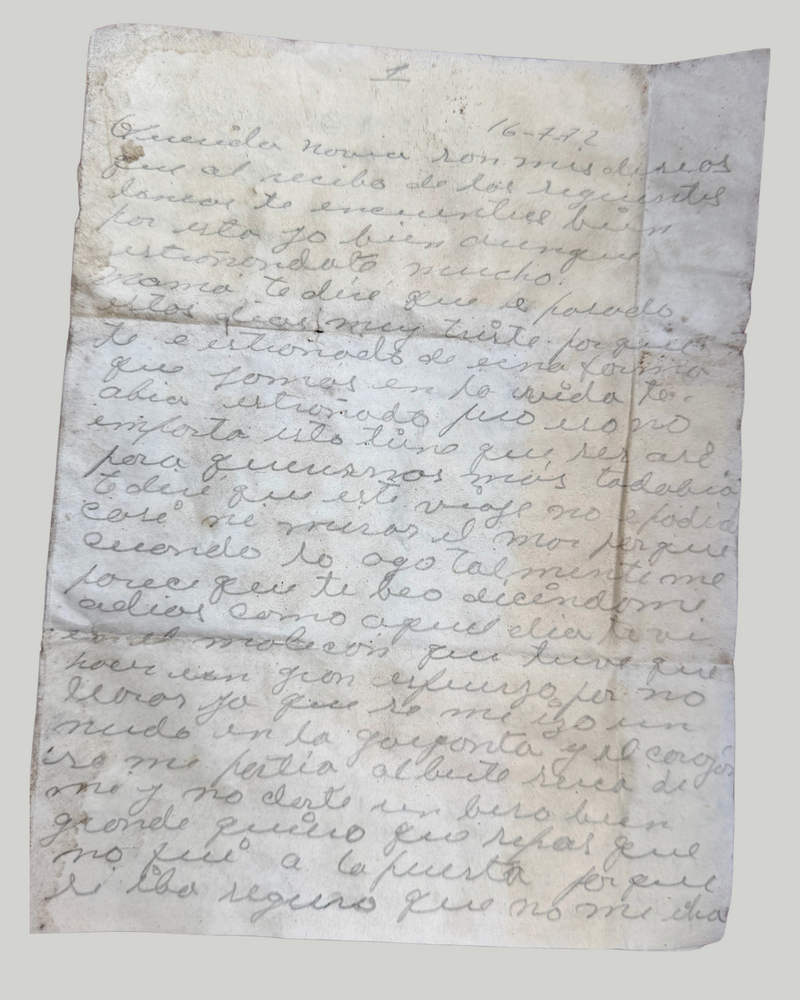
What the Ocean Kept
The pages that follow are tender in a way that feels almost too private to read, and yet here they are, on a beach in Cuba more than fifty years after they were written. Did this letter ever reach the woman it was meant for?
Pablo reassures her his heart is entirely hers. Todo mi corazón es tuyo y tu no puedes dudarlo. All my heart is yours, and you have no reason to doubt it. He talks about their wedding, about becoming husband and wife, about sending word by telegram the moment his ship reaches port so she'll know he's safe. He asks after his own mother, tells her not to worry over nothing.
Near the end, after sending love to her family, to her brothers, to everyone at home, he signs off simply.
Tuyo.
Yours.
Pablo.

I might use this letter in my art one day. If I do, it will be with care, likely photographed and preserved rather than altered. A way of honouring what it is, not just what it can become.
What I Don't Know
I don't know who Pablo was, or what happened to him. I don't know if he made it to wherever the ship was taking him, or if his novia was waiting when he arrived. Given the date, and the fact that this letter turned up on a Cuban shore, it's hard not to wonder if he was one of the many who left the island during those years, torn between the people he loved and a future he had to reach for anyway. The letter never says where the ship was headed, only that leaving hurt more than he could put into words, and he tried anyway.
That's the part that stays with me. Not the mystery of where he went, but the honesty of how he said goodbye. A man on a boat, homesick and lovesick in the same breath, trying to make an ocean feel smaller with a pencil and a piece of paper.
Fifty Years, and Barely a Tear
Here's the part I keep turning over. This letter is fifty-four years old, and it isn't in ruins. The edges have gone soft, a few corners are torn, there's staining on that fourth page, but the pencil is still readable and the folds still hold their shape. That isn't usually what fifty-four years leaves behind. I'm 54 myself, and I can attest to that.
Part of me wanted it to be a message in a bottle. There's something irresistible about that idea. A letter meant for one person, sealed and sent out into the world instead, drifting for decades until it washes ashore for a stranger to find.
But the more I looked at the letter, the less that story held up. A bottle would have kept the corners from tearing the way they have, and sealed glass rarely lets in staining like this gradually, over years. What I think actually happened is less romantic, and probably closer to the truth.
My guess is it wasn't out in the elements for fifty-four years. It was likely somewhere dry for most of that time. A drawer, a box of letters, a family Bible, the kind of place people used to keep what they couldn't throw away.
I found it well up on the dry sand, near a cluster of small, long-abandoned shacks, no hydro lines running to any of them, but with the unmistakable feel of a place people once called home. It wouldn't surprise me if this letter came from inside one of those shacks rather than the sea at all, left behind in a drawer when whoever lived there finally moved on, then carried out by wind or weather sometime since. That would explain the water damage without the wear you'd expect from decades adrift. A bit of rain finding its way through a gap in an old roof, not years in salt water.
I like to imagine it sat safe for most of its life, kept by someone who loved Pablo, or loved the person he was writing to, and only made its way outdoors recently. Which means it isn't just a relic of 1972. It's also a small piece of right now, of somebody's home, unsettled just enough to let this slip out and land on that stretch of sand for me to find.
I think that's part of why it found its way to me. I spend my days working with layers, with things that carry history, with the idea that beauty and healing can live inside what's worn and imperfect. Pablo's letter is exactly that. A worn, imperfect, beautiful thing that survived fifty years of tides to remind me why I do this work in the first place.
If these old pages could talk beyond what's written on them, I imagine they'd just say what Pablo already did.
Tuyo. Yours, still.
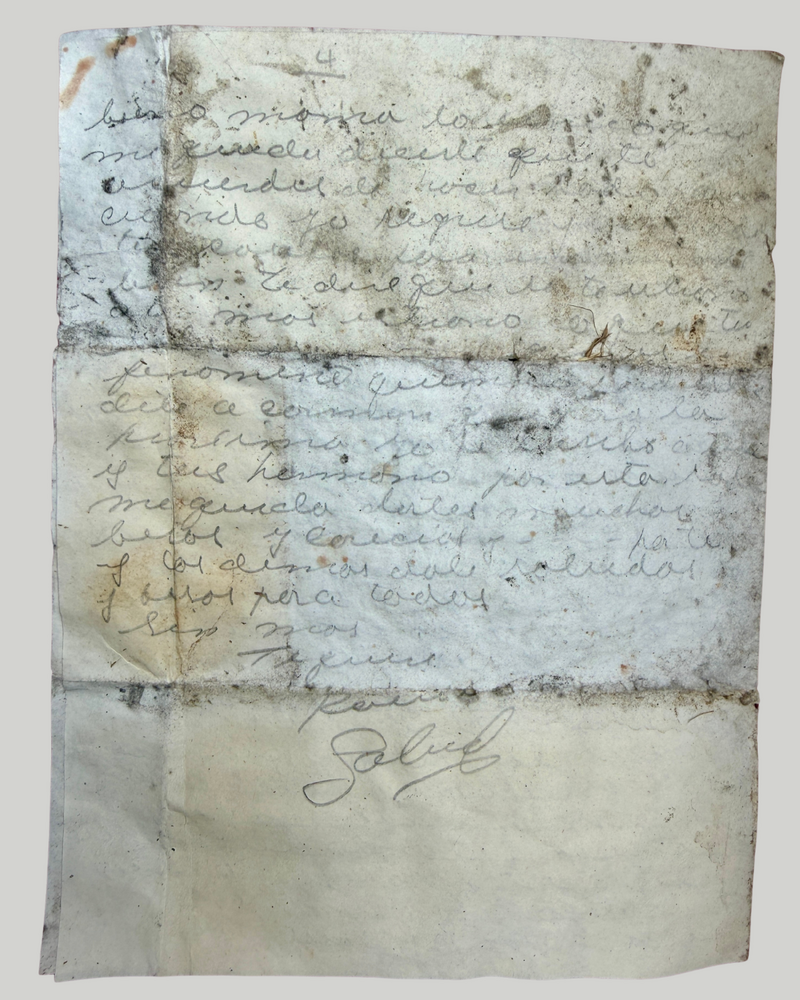
I don't know what happened to Pablo, or whether his letter ever said what he needed it to say to the person who mattered most. But it said something to me, fifty-four years later, on a beach I wasn't even meant to be walking on. That's part of why I keep doing this work. You never know which piece, which scrap, which small forgotten thing is going to be the one that reaches someone.
If you're looking for a gentle space to work with pieces of your own, I'd love to welcome you into one of my workshops. You can see what's available at Creative Delight Studio.
P.S. I share finds like this one, along with creative prompts and studio musings, in my weekly newsletter. It's a small, gentle space in your inbox, and you're always welcome to join us here.










Comments